Utilizing AI to Help You Refine Your Ideas into Frameworks
Being Right Isn’t Enough
I am not a skilled communicator. My ideas so often outrun my ability to describe them that sometimes it’s hard not to give in to frustration when I have a breakthrough realization that no one else seems to understand or accept.
Being right counts for very little if you can’t persuade people and mobilize resources. I’m well past the time in my life when I would get any kind of smug, cold comfort in being proven right after the fact. I used to tell my team members that conversation and persuasion are the most powerful tools a designer has at their disposal. It’s not just a designer’s job to design, but to persuade, convince, and win people over to your cause.
What I find I am good at is noticing. Over time I take note of what has worked, and what hasn’t. I’m also good at adaption and creating frameworks in my mind. I don’t stick with something dogmatically; if it doesn’t work, I discard it, even if it served me in a different context. So over time I compile a working framework of how to approach all of the big problems I’m facing.
The Challenge of Making Internal Logic Understood
The challenge comes in getting that framework out of my head in a format that someone can easily understand and utilize. My experiences and insights are often won on a personal level, so what may be immediately intuitive to me may seem obtuse or obscure to someone else.
For example, I recently posted on LinkedIn saying that job search candidates should be able to show in their resume and in their interviews what kind of impact their work had. It is critical that any job candidate can understand and articulate how work turns out differently when they are involved. I got significant pushback on this idea, saying that it was unrealistic for designers to have access to hard numbers on how their work impacted sales.
In my mind, it was clear that impact does not necessarily equal hard numbers. Hard numbers are great when you can get them, but they aren’t the only way to demonstrate impact. What was not clear to me, however, was how to articulate this in a way that could be picked up and used by others.
Using AI to Turn Learned Experience into Structure
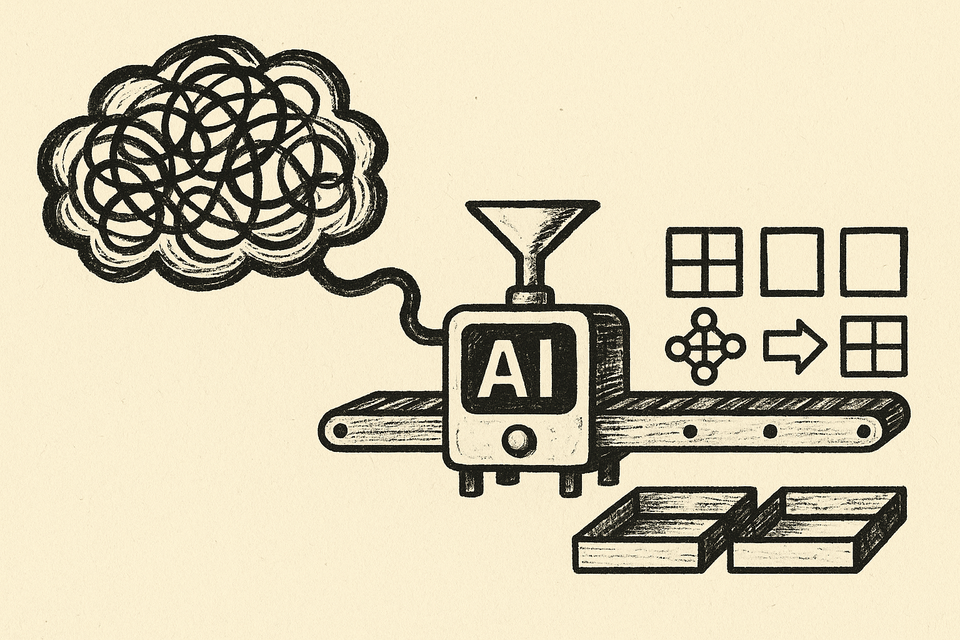
Getting to the point where I could articulate this, however, didn’t come naturally. I typed up all my thoughts, dumped it into AI, and asked it to help me sort the different examples of evidence into buckets I could use for easy categorization. It came up with two additional categories:
- Directional evidence. This is evidence that shows movement toward a business result, even if you can’t tie the result directly to business impact. This can include usability, workflow, and process improvements (for example, increased onboarding speed, reduced user errors).
- Soft evidence, which is more anecdotal or qualitative (user quotes, building stakeholder alignment, decreasing user frustration). Having all three at your disposal is ideal, but even just having one is great.
So here was a simple, one-dimensional framework: evidence of impact can follow a scale of hard evidence > directional evidence > soft evidence.
As I was exploring this, I realized that the objective of most business initiatives I used as examples could be tied back to one of three metrics:
- Increasing revenue
- Decreasing customer churn
- Decreasing internal costs
Now I could take my framework and apply it across these three different metrics and have something more tangible for people to work with:
| Hard Evidence | Directional Evidence | Soft Evidence | |
| Increase revenue | |||
| Decrease churn | |||
| Decrease internal costs |
Additionally, I started working on developing different lenses that would impact the metrics that would matter to different types of organizations. For example, if you're working for an organization that focuses on B2B sales, the metrics that the organization cares about might be very different than a consumer-focused or non-profit organization. This is also important to understand retroactively. If you worked at a B2B business but are applying for a job at a consumer-focused startup, you'll need to be able to speak to the types of metrics that are important to them if you want to land the job.
All of this was sparked by AI's ability to create some simple structure for my thinking.
The Role of AI in Revealing (Not Replacing) My Thinking
Left to my own devices, my ideas tend to live as instinct; something that I intuitively understand, but that is not fully formed. I know what’s effective, but I don’t always have the language or structure to show someone else the logic underneath. AI is a tool that helps me externalize those learned experiences into something that can be easily understood by others. By dumping my raw thoughts into it and asking it to help me categorize, contrast, and refine, I could finally see the underlying framework I’d been relying on for years without ever articulating.
In this case, AI helped me uncover a simple hierarchy of evidence and connect it to the universal metrics driving every business. It turned a foggy, internal sense of “this matters” into a repeatable structure others can use to articulate their own impact.
Why It Matters
In design, it is critical that we turn raw intuition, years of accumulated training and learning, and the messy internal frameworks we rely on into stories and structures that someone else can actually use. Our internal logic has to become shared logic.
Frameworks aren’t meant to be perfect philosophical systems. Frameworks are bridges to help someone who hasn’t lived our experiences still leverage our insights and our learning. They invite people into our thinking rather than asking them to take our word for it.
Being a designer (or any kind of problem-solver), is as much about translation as creation. It’s about making the invisible visible. It’s about taking whatever you’ve learned the hard way and packaging it so others don’t have to stumble through the same fog.

Member discussion